AI Robotics: Hands-On Learning vs. Theory – Singapore Edition
Singapore is rapidly embracing automation and artificial intelligence. Robotics is at the forefront of this technological wave. Are you interested in learning about AI robotics? Are you trying to decide between theoretical knowledge and practical application? This article explores the benefits of hands-on AI robotics learning, comparing it to traditional theoretical approaches. We will discuss the advantages for makers, students, engineers, and hobbyists in Singapore.
Understanding the Divide: Theory vs. Practice
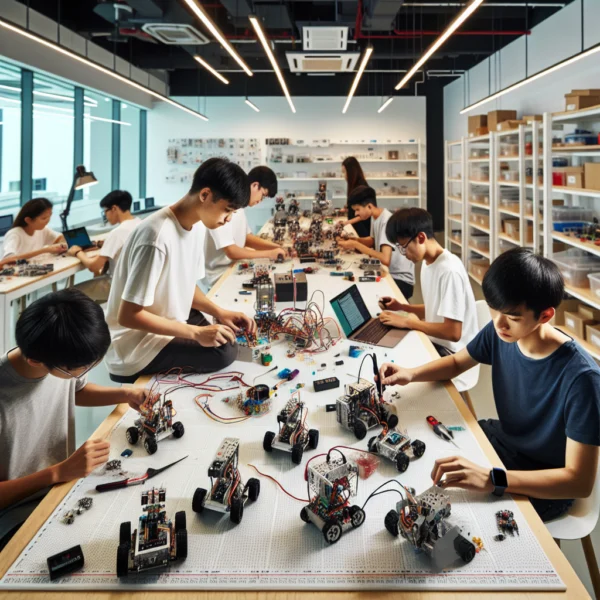
Many traditional educational paths focus heavily on theory. You might spend hours studying algorithms and mathematical models. You might learn about kinematics and dynamics on paper. However, this theoretical knowledge can feel disconnected from the real world. It can be hard to translate concepts into working robots. This is where hands-on learning shines. Hands-on learning allows you to build, test, and debug real robotic systems. It solidifies your understanding in a way that theory alone cannot.
The Allure of Applied Learning
Imagine building a robot that can navigate a maze. You’ll need to understand path planning algorithms. But you also need to deal with sensor noise, motor control, and physical constraints. These practical challenges are often glossed over in textbooks. Practical robotics training puts you face-to-face with these challenges. You learn to troubleshoot problems and find creative solutions. This builds confidence and a deep understanding of the entire robotic system.
Key Concepts in AI Robotics
AI robotics involves a blend of several core concepts. These include:
- Sensing: How robots perceive their environment using sensors like cameras, LiDAR, and tactile sensors.
- Planning: Algorithms that allow robots to decide on a course of action, such as path planning or task scheduling.
- Control: Techniques for controlling the robot’s movements and actions, ensuring accuracy and stability.
- Machine Learning: Training robots to learn from data and improve their performance over time. This often involves neural networks and reinforcement learning.
Very Large Area (VLA) here simply refers to a large area that the robot needs to be aware of.
Breaking Down a Practical Build: Line Following Robot
Let’s consider a simple, yet illustrative project: building a line-following robot. This project incorporates several key AI robotics concepts. You can build this with Arduino or Raspberry Pi. You also need line sensors, motors, and a chassis.
Step-by-Step: Building Your Line Follower
Here’s a simplified guide to building your own line-following robot:
- Hardware Assembly: Assemble the robot chassis. Attach the motors and wheels. Mount the line sensors facing downwards.
- Wiring: Connect the motors and sensors to your microcontroller (Arduino or Raspberry Pi).
- Programming: Write code to read the sensor values. Use these values to control the motor speeds. Adjust the motor speeds to keep the robot following the line.
- Calibration: Calibrate the sensors to accurately detect the line. Fine-tune the motor control parameters for smooth movement.
- Testing & Iteration: Test the robot on a line. Adjust the code and hardware as needed to improve performance.
The Role of Software
The software is the “brain” of your robot. It translates sensor data into motor commands. The control algorithm is crucial. A simple proportional-integral-derivative (PID) controller can work wonders. You can also explore more advanced AI techniques. Reinforcement learning can train the robot to follow the line even in challenging conditions. Examples include varying line thickness or noisy sensor data.
Benefits of Hands-On AI Robot Courses
Enrolling in hands-on robot courses offers significant advantages. You learn by doing. You gain practical experience. You build a portfolio of projects. These projects demonstrate your skills to potential employers. Hands-on training is especially valuable in Singapore’s competitive job market. You can find many AI robot courses and robot education programs offered locally.
From Theory to Application: The Power of Practical Learning
Hands-on projects help you bridge the gap between theory and application. You see how theoretical concepts work in the real world. You develop problem-solving skills that are essential for robotics engineers. You also learn to work with hardware and software tools. These tools are widely used in the industry. Practical experience significantly enhances your career prospects.
Why Choose Practical Robotics Training?
Opting for practical robotics training provides a distinct advantage. You learn to troubleshoot problems in real-time. You develop a deeper understanding of the limitations of different technologies. You also learn to work collaboratively with other engineers and makers. This collaborative environment fosters innovation and creativity. It prepares you for the challenges of real-world robotics projects.
Singapore’s Robotics Landscape and Education
Singapore is actively investing in robotics research and development. This creates opportunities for skilled robotics engineers. Local universities and polytechnics offer excellent robotics programs. Numerous private training providers offer specialized robot courses. These courses cover a wide range of topics. These topics include AI, machine learning, and embedded systems. Choosing the right course can significantly boost your career prospects in the field.
The Future of Robotics Education
The future of robotics education is moving towards more hands-on learning. Emphasis is being placed on project-based learning and real-world applications. This shift reflects the industry’s need for engineers. Engineers who are not just knowledgeable but also capable of building and deploying robots in real-world environments are needed. Embrace practical learning. You will be well-prepared for the exciting challenges and opportunities in the field of AI robotics.
Conclusion: Embrace the Hands-On Approach
While theoretical knowledge is important, hands-on experience is crucial for success in AI robotics. In Singapore, where technological advancement is a priority, practical skills are highly valued. By combining theoretical learning with hands-on projects, you can develop a comprehensive skillset that will set you apart in the competitive field of robotics. Embrace the challenge, build your own robots, and embark on a rewarding career in AI robotics!
🦾 Hands-on AI Robot Courses
Looking for practical robot education? Stop reading theory and start building.
- AI Robot Courses: Assemble a complete LeRobot arm in our 2-day intensive.
- Hardware Kits: Everything you need to learn robotics at home.
- VLA Training: Learn how modern AI controls machines.
Leave a Reply